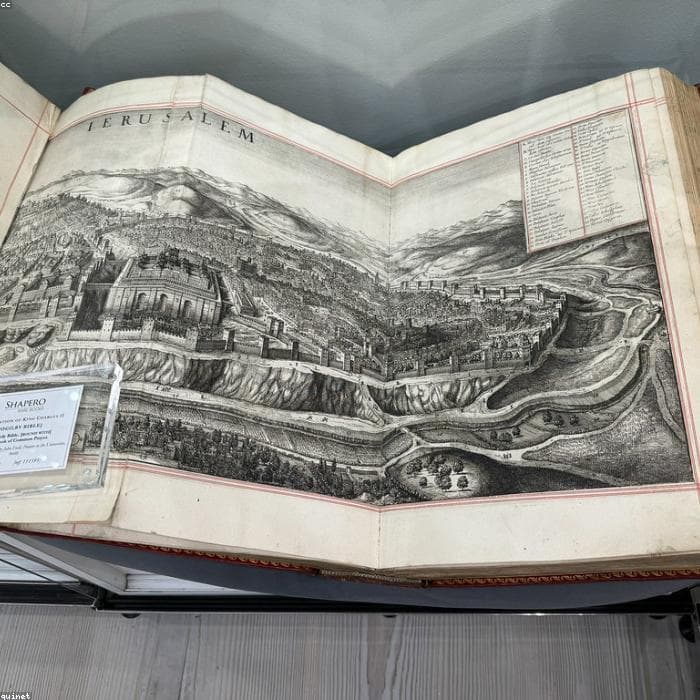
For years, rare books sat at the quieter end of the collecting world — admired, but seldom discussed in the same breath as art or antiquities. That is changing. Monuments of the printed age and the great illuminated manuscripts are finding a place in portfolios built for the long term, valued not only for their beauty but for the unusual steadiness with which the finest copies hold their worth. The reasons are worth understanding before you buy a single leaf.
The appeal is straightforward. Supply is genuinely fixed, condition can be graded with rare precision, and the best copies have a record of holding value through cycles that have unsettled more fashionable assets. A book is also, uniquely among collectibles, a thing you can read — scholarship and asset bound between the same boards.
Why supply is the whole story
Nothing concentrates value like a closed edition. A given book was printed in a finite number of copies centuries ago, and the figure only falls — to fire, damp, neglect and the slow attrition of use. Of those that survive, only a fraction are complete, clean and unsophisticated. The pool of truly fine copies is therefore small, fixed and shrinking, which is precisely the condition under which scarcity becomes durable.
Demand, meanwhile, need not be vast to move such a market. It takes only a handful of serious collectors and institutions pursuing the same shelf of great books for the best copies to become genuinely difficult to obtain — and difficulty, in this field, is the mother of value.
Condition is a language
Learn to read condition, because the trade speaks it fluently and prices in it precisely. The vocabulary is exact: a tall copy with generous margins, a crisp impression of the type or plates, an honest contemporary binding, the half-title and all the blanks present. Each term is a lever on value, and the gap between a fine copy and a merely good one is often a chasm.
Know, too, what quietly destroys worth. Washed and pressed leaves, supplied or facsimile pages, heavy restoration, an ex-library copy with its stamps and pockets — these are the sophistications that turn a great book into a compromised one. The first question to ask of any copy is not how rare, but how honest.
In rare books, condition is not a detail of the asset. It is the asset, spelled out leaf by leaf.
Editions, issues and points
Value lives in the particulars of printing. The first edition is only the beginning; within it, the first issue or state — identified by tiny points such as a corrected misprint, a cancelled leaf or a variant imprint — can separate an ordinary copy from an exceptional one. These distinctions can seem pedantic until you watch them decide a price.
This is where a good reference library earns its keep. The standard bibliographies exist precisely to settle such questions, and the collector who learns to use them buys with confidence where others guess. Knowledge of points is not trivia; it is the grammar of the market.
Provenance and association
A book carries its history in a way few objects can — in bookplates, inscriptions, annotations and the records of past sales. A clean institutional or private provenance reassures; an association copy, one owned or inscribed by a figure connected to the work, can transform it. The right hand on the flyleaf turns an object into a document.
As everywhere in collecting, continuity matters more than glamour. A modest but unbroken history, fully recorded, is worth more than an illustrious name attached to a copy whose recent decades cannot be accounted for. Completeness, the quality of the impression and a clean provenance matter more than rarity alone.
How the best copies behave
The finest copies are the most defensive assets in the field. When markets soften, it is the tired, the incomplete and the over-restored that fall first and furthest; the great copies are simply withdrawn and held, their owners under no pressure to sell. Quality does not merely command a premium — it confers patience, which is its own form of return.
Buy fewer, buy better. One great copy will outlast a shelf of compromises.
This is why the seasoned advice is always the same. One outstanding, fully documented copy will do more for a collection, and its eventual value, than a shelf of compromises bought for the thrill of acquisition.
Buying scholarship first
Treated as objects of scholarship first and assets second, fine books tend to reward both instincts at once. The collector who buys what genuinely interests them, learns the subject deeply, and insists on condition and provenance will, almost incidentally, have assembled something of lasting worth.
The market may have discovered antiquarian books; the pleasures that justified collecting them in the first place are unchanged. The portfolio tends to look after itself when the library is built with love and discipline in equal measure.
Share