When a marble portrait arrives for assessment, the first instrument is the eye — but it is rarely the last. Authenticating an antiquity is a conversation between connoisseurship and science, and a piece earns its place in the catalogue only when the two agree. What that conversation involves is worth setting out, because it is the same process that stands, invisibly, behind every antiquity we offer.
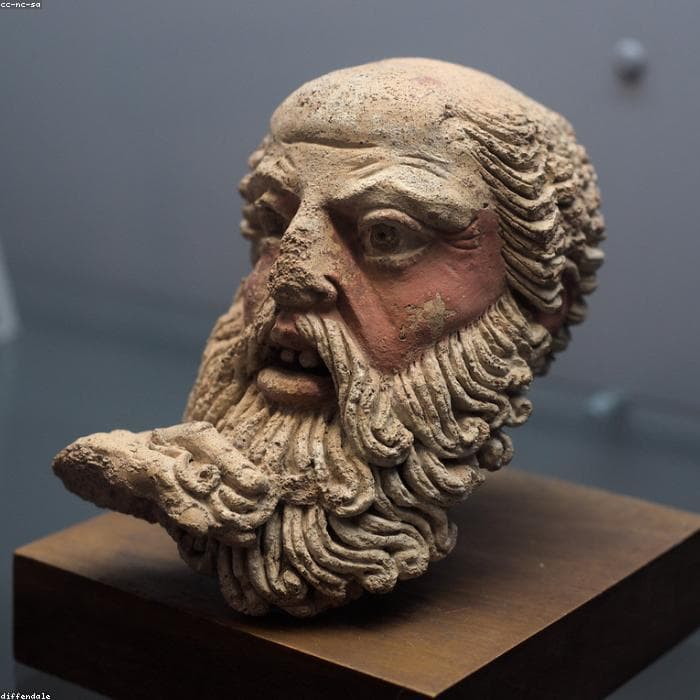
We begin with the carving itself: the handling of the hair, the treatment of the eyes, the weathering of the surface and the way the stone has aged. These are the marks a forger struggles to fake, because they are the marks of time rather than tools. They are also the marks that first tell a trained eye whether a head is right, long before any instrument is brought to bear.
The sculptor's hand
Every period and workshop has its habits, and the hand betrays them. The depth and rhythm of the drill in the hair, the cutting of the tear-ducts and irises, the transition from polished flesh to roughened ground — each follows conventions that shift across the centuries. A portrait that mixes the mannerisms of different eras, or renders a detail in a way no ancient carver would, declares itself to the patient observer.
Style is not proof, but it is the first filter. A piece that fails on style rarely survives the later tests; a piece that convinces on style has earned the right to the questions that follow. Connoisseurship, in other words, tells us where to look hardest.
Reading the surface
Stone records its history on its skin. Genuine burial leaves traces that are difficult to counterfeit: root-marks etched by plant growth, deposits lodged in undercuts and the folds of drapery, a weathering that follows the logic of how a piece lay in the ground. Authentic patina is rarely uniform; it gathers where it should and spares the prominent surfaces that handling would have worn.
Artificial ageing tends to betray itself by its very evenness, or by collecting in the wrong places — acids that bite too regularly, stains that pool where gravity and time never would. We examine the surface under magnification and raking light, asking a simple question: does the wear tell a story that the rest of the object confirms?
Time leaves a signature on stone. A forger can imitate the hand, but rarely the centuries.
Then the evidence
Surface analysis, an examination of root-marks and burial deposits, and — critically — the documented history of the piece all have to align. A portrait with an unbroken record back to a known mid-century collection is reassuring not because old collectors were infallible, but because the trail can be checked. Provenance does not replace the physical evidence; it corroborates it, and gives the eye and the instrument a third witness.
Where the history is thin, the physical case must be correspondingly strong — and even then, a gap will weigh on both confidence and value. The most satisfying attributions are those in which object, surface and paperwork each say the same thing in their own language.
We do not ask whether a piece could be genuine. We ask whether we can prove it.
Where science helps, and where it stops
Science narrows uncertainty; it rarely closes it on stone. Marble cannot be dated as directly as fired clay can by thermoluminescence, so analysis tends to address related questions: the geological source of the stone, the mineralogy of surface deposits, traces of ancient polychromy, the behaviour of the surface under ultraviolet light. Each finding is a constraint, not a verdict.
We are candid about these limits. A clever fake on genuinely ancient stone — a recut head, a modern face on an old fragment — is precisely the case that demands the eye and the record as much as the laboratory. No single test is a talisman; the strength lies in their agreement.
Marriages and recuttings
Not every doubtful piece is a modern invention. Some are genuine fragments improved into something more saleable — a battered head recut to sharpen its features, an ancient bust married to an unrelated base, a nose or an ear restored and quietly presented as original. These hybrids are often the hardest cases, because part of the object truly is old.
Here the discipline is to map exactly what is ancient, what is restored, and what is simply wrong — and to say so plainly. An honest account of a piece's interventions is not a weakness in a catalogue entry; it is the entry doing its job.
What the buyer receives
Only when the object, the science and the paperwork tell the same story does a piece reach you — and it reaches you with the documentation that lets the next custodian be as certain as we are. That means a clear statement of condition and restoration, the provenance as far as it can be traced, and the findings that support the attribution.
This is slow, unglamorous work, and it is the whole point. The pleasure of living with an ancient face is immeasurably greater when you are not, somewhere at the back of your mind, still wondering.
Share